Editor Integrations
VS Code (Official)
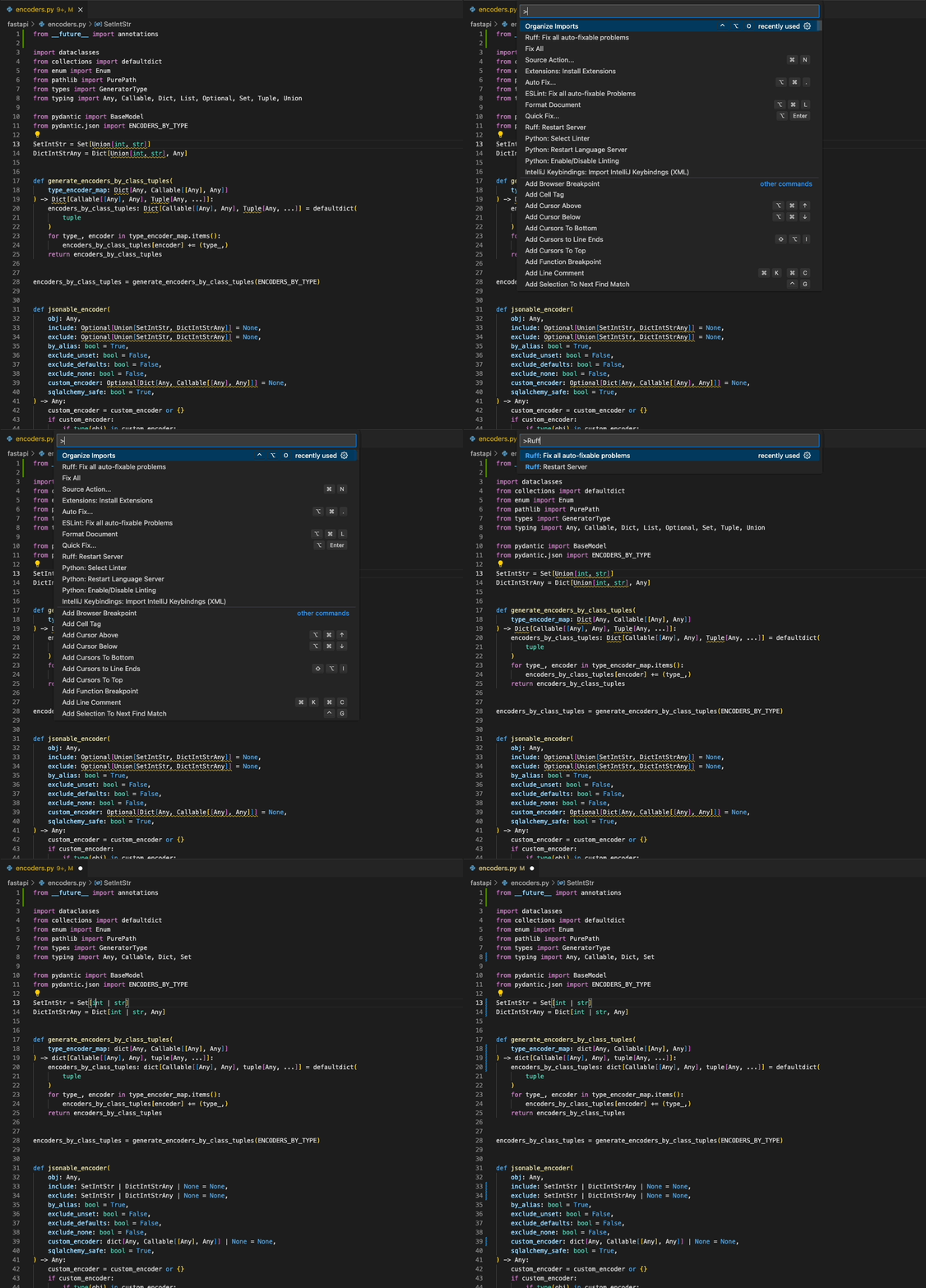
Download the Ruff VS Code extension, which supports autofix actions, import sorting, and more.
Language Server Protocol (Official)
Ruff supports the Language Server Protocol via the ruff-lsp Python package, available on PyPI.
ruff-lsp enables Ruff to be used with any editor that supports the Language Server Protocol, including Neovim, Sublime Text, Emacs, and more.
For example, to use ruff-lsp with Neovim, install ruff-lsp from PyPI along with nvim-lspconfig. Then, add something like the following to your init.lua:
-- See: https://github.com/neovim/nvim-lspconfig/tree/54eb2a070a4f389b1be0f98070f81d23e2b1a715#suggested-configuration
local opts = { noremap=true, silent=true }
vim.keymap.set('n', '<space>e', vim.diagnostic.open_float, opts)
vim.keymap.set('n', '[d', vim.diagnostic.goto_prev, opts)
vim.keymap.set('n', ']d', vim.diagnostic.goto_next, opts)
vim.keymap.set('n', '<space>q', vim.diagnostic.setloclist, opts)

-- Use an on_attach function to only map the following keys
-- after the language server attaches to the current buffer
local on_attach = function(client, bufnr)
  -- Enable completion triggered by <c-x><c-o>
  vim.api.nvim_buf_set_option(bufnr, 'omnifunc', 'v:lua.vim.lsp.omnifunc')

  -- Mappings.
  -- See `:help vim.lsp.*` for documentation on any of the below functions
  local bufopts = { noremap=true, silent=true, buffer=bufnr }
  vim.keymap.set('n', 'gD', vim.lsp.buf.declaration, bufopts)
  vim.keymap.set('n', 'gd', vim.lsp.buf.definition, bufopts)
  vim.keymap.set('n', 'K', vim.lsp.buf.hover, bufopts)
  vim.keymap.set('n', 'gi', vim.lsp.buf.implementation, bufopts)
  vim.keymap.set('n', '<C-k>', vim.lsp.buf.signature_help, bufopts)
  vim.keymap.set('n', '<space>wa', vim.lsp.buf.add_workspace_folder, bufopts)
  vim.keymap.set('n', '<space>wr', vim.lsp.buf.remove_workspace_folder, bufopts)
  vim.keymap.set('n', '<space>wl', function()
    print(vim.inspect(vim.lsp.buf.list_workspace_folders()))
  end, bufopts)
  vim.keymap.set('n', '<space>D', vim.lsp.buf.type_definition, bufopts)
  vim.keymap.set('n', '<space>rn', vim.lsp.buf.rename, bufopts)
  vim.keymap.set('n', '<space>ca', vim.lsp.buf.code_action, bufopts)
  vim.keymap.set('n', 'gr', vim.lsp.buf.references, bufopts)
  vim.keymap.set('n', '<space>f', function() vim.lsp.buf.format { async = true } end, bufopts)
end

-- Configure `ruff-lsp`.
local configs = require 'lspconfig.configs'
if not configs.ruff_lsp then
  configs.ruff_lsp = {
    default_config = {
      cmd = { 'ruff-lsp' },
      filetypes = { 'python' },
      root_dir = require('lspconfig').util.find_git_ancestor,
      init_options = {
        settings = {
          args = {}
        }
      }
    }
  }
end
require('lspconfig').ruff_lsp.setup {
  on_attach = on_attach,
}
Upon successful installation, you should see Ruff's diagnostics surfaced directly in your editor:

To use ruff-lsp with other editors, including Sublime Text and Helix, see the ruff-lsp documentation.
Language Server Protocol (Unofficial)
Ruff is also available as the python-lsp-ruff plugin for python-lsp-server, both of which are installable from PyPI:
pip install python-lsp-server python-lsp-ruff
The LSP server can then be used with any editor that supports the Language Server Protocol.
For example, to use python-lsp-ruff with Neovim, add something like the following to your init.lua:
require'lspconfig'.pylsp.setup {
  settings = {
    pylsp = {
      plugins = {
        ruff = {
          enabled = true
        },
        pycodestyle = {
          enabled = false
        },
        pyflakes = {
          enabled = false
        },
        mccabe = {
          enabled = false
        }
      }
    }
  },
}
Vim & Neovim
Ruff can be integrated into any editor that supports the Language Server Protocol via ruff-lsp (see: Language Server Protocol), including Vim and Neovim.
It's recommended that you use ruff-lsp, the officially supported LSP server for Ruff.
However, Ruff is also available as part of the coc-pyright extension for coc.nvim.
let g:ale_linters = { "python": ["ruff"] }
let g:ale_fixers = {
\       "python": ["black", "ruff"],
\}
tools:
  python-ruff: &python-ruff
    lint-command: "ruff check --config ~/myconfigs/linters/ruff.toml --quiet ${INPUT}"
    lint-stdin: true
    lint-formats:
      - "%f:%l:%c: %m"
    format-command: "ruff check --stdin-filename ${INPUT} --config ~/myconfigs/linters/ruff.toml --fix --exit-zero --quiet -"
    format-stdin: true
local null_ls = require("null-ls")

null_ls.setup({
    sources = {
        null_ls.builtins.formatting.ruff,
        null_ls.builtins.diagnostics.ruff,
    }
})
PyCharm (External Tool)
Ruff can be installed as an External Tool in PyCharm. Open the Preferences pane, then navigate to “Tools”, then “External Tools”. From there, add a new tool with the following configuration:

Ruff should then appear as a runnable action:

PyCharm (Unofficial)
Ruff is also available as the Ruff plugin on the IntelliJ Marketplace (maintained by @koxudaxi).
TextMate (Unofficial)
Ruff is also available via the textmate2-ruff-linter bundle for TextMate.
GitHub Actions
GitHub Actions has everything you need to run Ruff out-of-the-box:
name: CI
on: push
jobs:
  build:
    runs-on: ubuntu-latest
    steps:
      - uses: actions/checkout@v3
      - name: Install Python
        uses: actions/setup-python@v4
        with:
          python-version: "3.11"
      - name: Install dependencies
        run: |
          python -m pip install --upgrade pip
          pip install ruff
      # Include `--format=github` to enable automatic inline annotations.
      - name: Run Ruff
        run: ruff check --format=github .