| [](https://pycqa.github.io/isort/) |
| |
| ------------------------------------------------------------------------ |
| |
| [](https://badge.fury.io/py/isort) |
| [][pypi status] |
| [](https://github.com/PyCQA/isort/actions/workflows/test.yml) |
| [](https://github.com/PyCQA/isort/actions/workflows/lint.yml) |
| [](https://codecov.io/gh/pycqa/isort) |
| [](https://pypi.org/project/isort/) |
| [](https://pepy.tech/project/isort) |
| [](https://github.com/psf/black) |
| [](https://pycqa.github.io/isort/) |
| [](https://deepsource.io/gh/pycqa/isort/?ref=repository-badge) |
| |
| [pypi status]: https://pypi.org/project/isort/ |
| _________________ |
| |
| [Read Latest Documentation](https://pycqa.github.io/isort/) - [Browse GitHub Code Repository](https://github.com/pycqa/isort/) |
| _________________ |
| |
| isort your imports, so you don't have to. |
| |
| isort is a Python utility / library to sort imports alphabetically and |
| automatically separate into sections and by type. It provides a command line |
| utility, Python library and [plugins for various |
| editors](https://github.com/pycqa/isort/wiki/isort-Plugins) to |
| quickly sort all your imports. It requires Python 3.10+ to run but |
| supports formatting Python 2 code too. |
| |
| - [Try isort now from your browser!](https://pycqa.github.io/isort/docs/quick_start/0.-try.html) |
| - [Using black? See the isort and black compatibility guide.](https://pycqa.github.io/isort/docs/configuration/black_compatibility.html) |
| - [isort has official support for pre-commit!](https://pycqa.github.io/isort/docs/configuration/pre-commit.html) |
| |
| 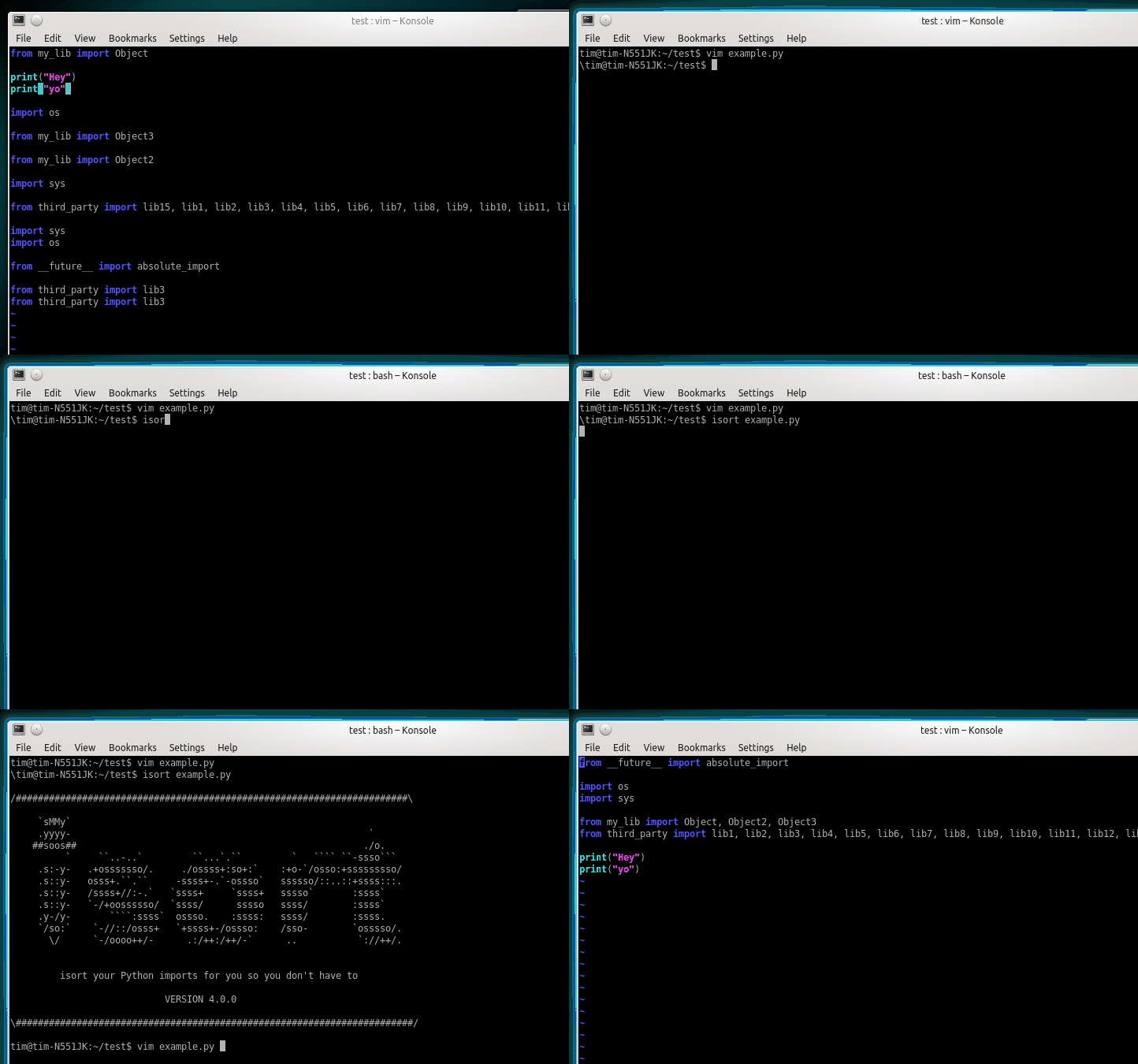 |
| |
| Before isort: |
| |
| ```python |
| from my_lib import Object |
| |
| import os |
| |
| from my_lib import Object3 |
| |
| from my_lib import Object2 |
| |
| import sys |
| |
| from third_party import lib15, lib1, lib2, lib3, lib4, lib5, lib6, lib7, lib8, lib9, lib10, lib11, lib12, lib13, lib14 |
| |
| import sys |
| |
| from __future__ import absolute_import |
| |
| from third_party import lib3 |
| |
| print("Hey") |
| print("yo") |
| ``` |
| |
| After isort: |
| |
| ```python |
| from __future__ import absolute_import |
| |
| import os |
| import sys |
| |
| from third_party import (lib1, lib2, lib3, lib4, lib5, lib6, lib7, lib8, |
| lib9, lib10, lib11, lib12, lib13, lib14, lib15) |
| |
| from my_lib import Object, Object2, Object3 |
| |
| print("Hey") |
| print("yo") |
| ``` |
| |
| ## Installing isort |
| |
| Installing isort is as simple as: |
| |
| ```bash |
| pip install isort |
| ``` |
| |
| ## Using isort |
| |
| **From the command line**: |
| |
| To run on specific files: |
| |
| ```bash |
| isort mypythonfile.py mypythonfile2.py |
| ``` |
| |
| To apply recursively: |
| |
| ```bash |
| isort . |
| ``` |
| |
| If [globstar](https://www.gnu.org/software/bash/manual/html_node/The-Shopt-Builtin.html) |
| is enabled, `isort .` is equivalent to: |
| |
| ```bash |
| isort **/*.py |
| ``` |
| |
| To view proposed changes without applying them: |
| |
| ```bash |
| isort mypythonfile.py --diff |
| ``` |
| |
| Finally, to atomically run isort against a project, only applying |
| changes if they don't introduce syntax errors: |
| |
| ```bash |
| isort --atomic . |
| ``` |
| |
| (Note: this is disabled by default, as it prevents isort from |
| running against code written using a different version of Python.) |
| |
| **From within Python**: |
| |
| ```python |
| import isort |
| |
| isort.file("pythonfile.py") |
| ``` |
| |
| or: |
| |
| ```python |
| import isort |
| |
| sorted_code = isort.code("import b\nimport a\n") |
| ``` |
| |
| ## Installing isort's for your preferred text editor |
| |
| Several plugins have been written that enable to use isort from within a |
| variety of text-editors. You can find a full list of them [on the isort |
| wiki](https://github.com/pycqa/isort/wiki/isort-Plugins). |
| Additionally, I will enthusiastically accept pull requests that include |
| plugins for other text editors and add documentation for them as I am |
| notified. |
| |
| ## Multi line output modes |
| |
| You will notice above the \"multi\_line\_output\" setting. This setting |
| defines how from imports wrap when they extend past the line\_length |
| limit and has [12 possible settings](https://pycqa.github.io/isort/docs/configuration/multi_line_output_modes.html). |
| |
| ## Indentation |
| |
| To change the how constant indents appear - simply change the |
| indent property with the following accepted formats: |
| |
| - Number of spaces you would like. For example: 4 would cause standard |
| 4 space indentation. |
| - Tab |
| - A verbatim string with quotes around it. |
| |
| For example: |
| |
| ```python |
| " " |
| ``` |
| |
| is equivalent to 4. |
| |
| For the import styles that use parentheses, you can control whether or |
| not to include a trailing comma after the last import with the |
| `include_trailing_comma` option (defaults to `False`). |
| |
| ## Intelligently Balanced Multi-line Imports |
| |
| As of isort 3.1.0 support for balanced multi-line imports has been |
| added. With this enabled isort will dynamically change the import length |
| to the one that produces the most balanced grid, while staying below the |
| maximum import length defined. |
| |
| Example: |
| |
| ```python |
| from __future__ import (absolute_import, division, |
| print_function, unicode_literals) |
| ``` |
| |
| Will be produced instead of: |
| |
| ```python |
| from __future__ import (absolute_import, division, print_function, |
| unicode_literals) |
| ``` |
| |
| To enable this set `balanced_wrapping` to `True` in your config or pass |
| the `-e` option into the command line utility. |
| |
| ## Custom Sections and Ordering |
| |
| isort provides configuration options to change almost every aspect of how |
| imports are organized, ordered, or grouped together in sections. |
| |
| [Click here](https://pycqa.github.io/isort/docs/configuration/custom_sections_and_ordering.html) for an overview of all these options. |
| |
| ## Skip processing of imports (outside of configuration) |
| |
| To make isort ignore a single import simply add a comment at the end of |
| the import line containing the text `isort:skip`: |
| |
| ```python |
| import module # isort:skip |
| ``` |
| |
| or: |
| |
| ```python |
| from xyz import (abc, # isort:skip |
| yo, |
| hey) |
| ``` |
| |
| To make isort skip an entire file simply add `isort:skip_file` to the |
| module's doc string: |
| |
| ```python |
| """ my_module.py |
| Best module ever |
| |
| isort:skip_file |
| """ |
| |
| import b |
| import a |
| ``` |
| |
| ## Adding or removing an import from multiple files |
| |
| isort can be ran or configured to add / remove imports automatically. |
| |
| [See a complete guide here.](https://pycqa.github.io/isort/docs/configuration/add_or_remove_imports.html) |
| |
| ## Using isort to verify code |
| |
| The `--check-only` option |
| ------------------------- |
| |
| isort can also be used to verify that code is correctly formatted |
| by running it with `-c`. Any files that contain incorrectly sorted |
| and/or formatted imports will be outputted to `stderr`. |
| |
| ```bash |
| isort **/*.py -c -v |
| |
| SUCCESS: /home/timothy/Projects/Open_Source/isort/isort_kate_plugin.py Everything Looks Good! |
| ERROR: /home/timothy/Projects/Open_Source/isort/isort/isort.py Imports are incorrectly sorted. |
| ``` |
| |
| One great place this can be used is with a pre-commit git hook, such as |
| this one by \@acdha: |
| |
| <https://gist.github.com/acdha/8717683> |
| |
| This can help to ensure a certain level of code quality throughout a |
| project. |
| |
| ## Git hook |
| |
| isort provides a hook function that can be integrated into your Git |
| pre-commit script to check Python code before committing. |
| |
| [More info here.](https://pycqa.github.io/isort/docs/configuration/git_hook.html) |
| |
| ## Spread the word |
| |
| [](https://pycqa.github.io/isort/) |
| |
| Place this badge at the top of your repository to let others know your project uses isort. |
| |
| For README.md: |
| |
| ```markdown |
| [](https://pycqa.github.io/isort/) |
| ``` |
| |
| Or README.rst: |
| |
| ```rst |
| .. image:: https://img.shields.io/badge/%20imports-isort-%231674b1?style=flat&labelColor=ef8336 |
| :target: https://pycqa.github.io/isort/ |
| ``` |
| |
| ## Security contact information |
| |
| To report a security vulnerability, please use the [Tidelift security |
| contact](https://tidelift.com/security). Tidelift will coordinate the |
| fix and disclosure. |
| |
| ## Why isort? |
| |
| isort simply stands for import sort. It was originally called |
| "sortImports" however I got tired of typing the extra characters and |
| came to the realization camelCase is not pythonic. |
| |
| I wrote isort because in an organization I used to work in the manager |
| came in one day and decided all code must have alphabetically sorted |
| imports. The code base was huge - and he meant for us to do it by hand. |
| However, being a programmer - I\'m too lazy to spend 8 hours mindlessly |
| performing a function, but not too lazy to spend 16 hours automating it. |
| I was given permission to open source sortImports and here we are :) |
| |
| ------------------------------------------------------------------------ |
| |
| [Get professionally supported isort with the Tidelift |
| Subscription](https://tidelift.com/subscription/pkg/pypi-isort?utm_source=pypi-isort&utm_medium=referral&utm_campaign=readme) |
| |
| Professional support for isort is available as part of the [Tidelift |
| Subscription](https://tidelift.com/subscription/pkg/pypi-isort?utm_source=pypi-isort&utm_medium=referral&utm_campaign=readme). |
| Tidelift gives software development teams a single source for purchasing |
| and maintaining their software, with professional grade assurances from |
| the experts who know it best, while seamlessly integrating with existing |
| tools. |
| |
| ------------------------------------------------------------------------ |
| |
| Thanks and I hope you find isort useful! |
| |
| ~Timothy Crosley |
